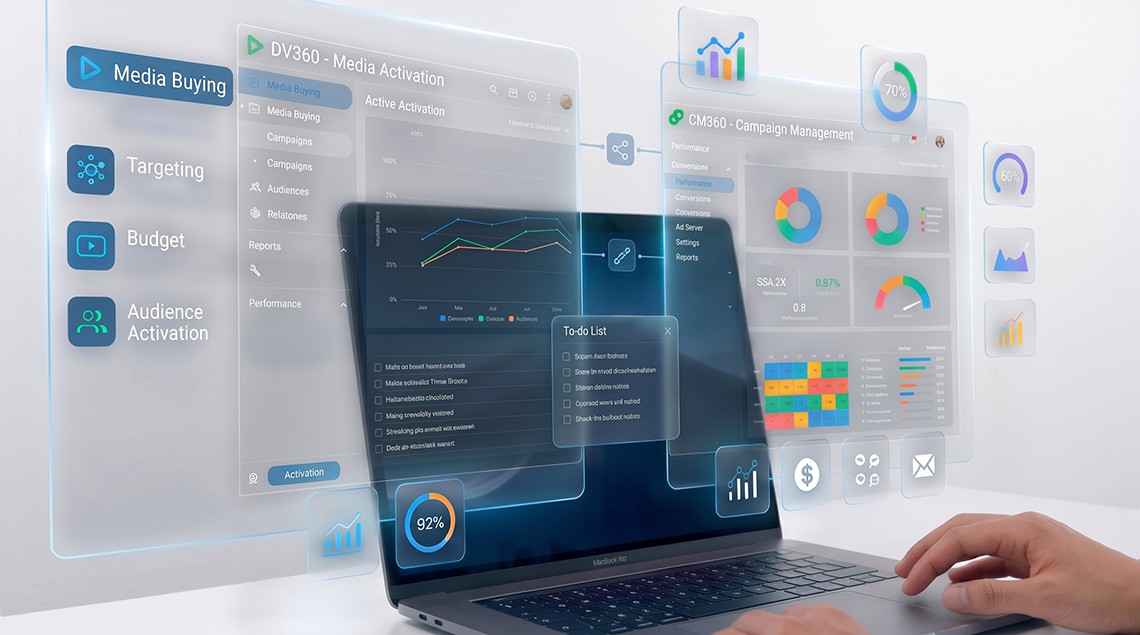
Google shipped a substantial set of updates to Display & Video 360 (DV360) and Campaign Manager 360 (CM360) during the second half of 2026. The releases separate into three categories: those applied at account level by default, those that remain inactive until explicitly configured, and those that warrant controlled testing before Q4 and 2027 budgets are committed. Classifying each release correctly determines whether quarter-on-quarter reporting remains interpretable. This analysis covers what shipped between July and December 2026, market availability in Europe, and the sequencing that adoption requires.
Key points: AI now assists planning and campaign construction in DV360. CTV buying moves from volume allocation towards deduplicated reach and frequency thresholds. CM360 consolidates creative governance while DV360 retains activation and bidding. New measurement signals alter conversion capture methodology, which is distinct from a change in campaign performance. Several releases launched in the United States first and remain unavailable in European markets.
The H2 2026 releases span four areas in DV360 (planning, buying, optimisation, measurement) and three in CM360 (creative management, measurement infrastructure, reporting). The defining characteristic of the cycle is the consolidation between the two platforms: creative assets are governed in CM360, activated through DV360, and measured back in CM360, with fewer manual handovers at each stage.
Read individually, most releases appear incremental. Read as a set, they relocate where work occurs within a campaign cycle and reassign ownership of several steps between ad operations and trading teams.
Three constraints are shaping the current release cycle. Identifier-based measurement is degrading, which moves conversion capture towards first-party data and modelling. Audience attention is distributed across YouTube, connected TV (CTV), linear television and digital video, which makes channel-isolated planning increasingly inaccurate at the total reach level. And campaign construction has remained predominantly manual, which is the layer Google is now automating.
These constraints predate 2026. What distinguishes the H2 cycle is that DV360 and CM360 are being restructured against all three simultaneously rather than addressed through separate feature tracks.
Five releases address this layer. AI Planning in Reach Planner interprets a campaign brief and produces an initial media plan and forecast. The Reach Curve API exposes reach and frequency forecast curves to proprietary planning environments rather than confining forecasting to the DV360 interface. Demand Gen Surface Control forecasts the expected distribution across YouTube In-Stream, In-Feed, Shorts, Discover and Gmail instead of treating demand as a single aggregate pool. AI Campaign Builder ingests a media plan spreadsheet and generates the insertion order and line item hierarchy from it. GenUI Custom Dashboards produce persistent reporting views from natural language prompts.
The dependency is unchanged: output quality is bounded by brief quality and data integrity. Automation compresses the build phase without altering the validation requirement. Baseline assumptions, inventory accessibility and the coherence between the plan and the commercial objective still require assessment by a planner with account-level context.
The planning question moves from CTV volume allocation towards reach composition: which audiences are being reached, at what frequency, and what incremental reach the channel contributes beyond existing video activity. Three releases support that shift. Live Aware Bidding increases competitiveness against live signals during major sports and entertainment broadcasts. Target Frequency allows a weekly or monthly CTV frequency goal, with delivery optimised towards that average rather than constrained by a flat cap. Pause Ads are launching with selected partners during H2 2026, introducing an additional CTV placement to the mix.
Two optimisation changes apply to YouTube. Reach at Frequency optimises insertion orders towards maximum unique reach at a defined frequency threshold. Custom Bidding on YouTube allows advertisers to define impression scoring logic against business objectives, consistent with how custom bidding already operates on other inventory types. Both depend on clean signal pipelines, a quantified business objective and structured testing, which concentrates their value in accounts where that foundation already exists.
Market availability varies considerably, and several of the most referenced releases remain inaccessible to European advertisers. First-party audience targeting for connected TV is live in the United States and is not available in the UK, the EEA or Switzerland. Household Reach Measurement, which produces a deduplicated view of campaign reach at household level rather than at individual level, is in beta. Lookalike Audiences for third-party video were scheduled to enter beta in Q4 2026.
Availability is the variable most frequently omitted from feature announcements. A release described as live is commonly live in a single market. For European advertisers, the operative question per release is accessibility in the markets actually being bought, and which existing capability covers the requirement until availability extends.
Three measurement releases modify conversion capture. Google Signals leverages authenticated signals to improve observed conversion visibility across app, web and CTV. Enhanced Conversions applies hashed first-party data to strengthen conversion measurement where third-party identifiers are restricted, with rollout beginning on non-CTV inventory. Engaged View Conversions (EVC) are reported as a distinct metric alongside click-through and view-through conversions, attributing conversions that follow a qualifying video engagement rather than an unqualified view.
The methodological consequence is material. When a reported conversion volume shifts after one of these changes takes effect, the campaign has not necessarily delivered differently: the capture and modelling method has changed. Isolating one from the other requires a documented baseline established before the change, together with the methodology that produced it. Accounts lacking that baseline will be unable to substantiate a quarter-on-quarter comparison.
CM360 consolidates creative governance. YouTube auction creative can be uploaded and reviewed within CM360 and synchronised into DV360 line items, with approved assets also shareable into Google Ads. Creative rotations and copy amendments are handled centrally without re-trafficking live placements.
Dynamic Creative Optimization moves into standard ad operations rather than remaining a specialist configuration, with Studio evolving into a creative workspace inside CM360 and reporting available at variant level. On the reporting layer, Path to Conversions provides an aggregated view of touchpoints contributing to conversion, Assisted Conversions returns as a metric for touchpoints contributing outside last-interaction credit, a reach dashboard consolidates unique reach, overlap, frequency curves and demographic distribution, and Ask Advisor permits natural language querying of ad server reporting data.
Not through simultaneous adoption. The sequence that withstands scrutiny is an end-to-end audit of the existing DV360 and CM360 configuration, from planning through Floodlight implementation, reporting and first-party data readiness; selection of a limited number of releases addressing an identified operational constraint; controlled piloting; and establishment of a clean measurement baseline prior to activation.
Execution is rarely the constraint. The determining work is assessing which releases are material for a given account, in a given market, against a given data foundation, and establishing which can safely be deferred. That assessment is the substance of our client work: reviewing accounts against what has actually shipped in their markets, identifying workflow and tagging gaps, designing pilots that produce a readable result, and ensuring the measurement configuration can distinguish a methodology shift from a performance shift.
Q : What are the main DV360 updates in H2 2026?
R : DV360’s H2 2026 releases cover AI-assisted planning (AI Planning in Reach Planner, Reach Curve API, Demand Gen Surface Control), campaign construction (AI Campaign Builder, GenUI Custom Dashboards), CTV and YouTube buying (Live Aware Bidding, Target Frequency, Pause Ads, Reach at Frequency, Custom Bidding on YouTube), audience expansion (Lookalike, Impression-Based and Commerce Audiences), and measurement (Google Signals, Enhanced Conversions, Engaged View Conversions).
Q : What is an Engaged View Conversion in DV360?
R : An Engaged View Conversion (EVC) attributes a conversion that follows a qualifying video engagement rather than an impression or a click. Under the H2 2026 releases, EVCs are reported as a distinct metric alongside click-through and view-through conversions, adding a separate reporting line rather than modifying an existing one.
Q : Is first-party audience targeting for CTV available in Europe?
R : No. First-party audience targeting for connected TV launched in the United States and is not available in the UK, the EEA or Switzerland. Market availability should be confirmed per release before any H2 2026 capability is built into a European media plan.
Q : Do the H2 2026 updates apply automatically to an account?
R : Partially. A subset of releases applies at account level by default and will surface in reporting without activation, while others remain inactive until configured. An account-level audit is the only reliable method of establishing which category each release occupies for a given configuration.
Q : Why did conversion volumes change after the H2 2026 measurement updates?
R : New signals and modelling methods alter how conversions are captured and attributed, which can move a reported figure independently of campaign delivery. A measurement baseline documented before activation is what makes the two separable afterwards.
Q : What is the division between DV360 and CM360 after the H2 2026 updates?
R : CM360 governs creative assets and measures reach and conversion paths, while DV360 handles media planning, buying, activation and bidding. The H2 2026 releases tighten the connection between the two, with creative synchronising from CM360 into DV360 and measurement returning through CM360.